
What Horses Can Teach Us About Healing: Our Team’s Experience with Equine Therapy
When most people think of therapy, they picture a quiet office, a comfortable chair, and a conversation. While talk therapy is incredibly valuable, it isn’t the only way healing happens. Sometimes the most meaningful insights come without many words at all.
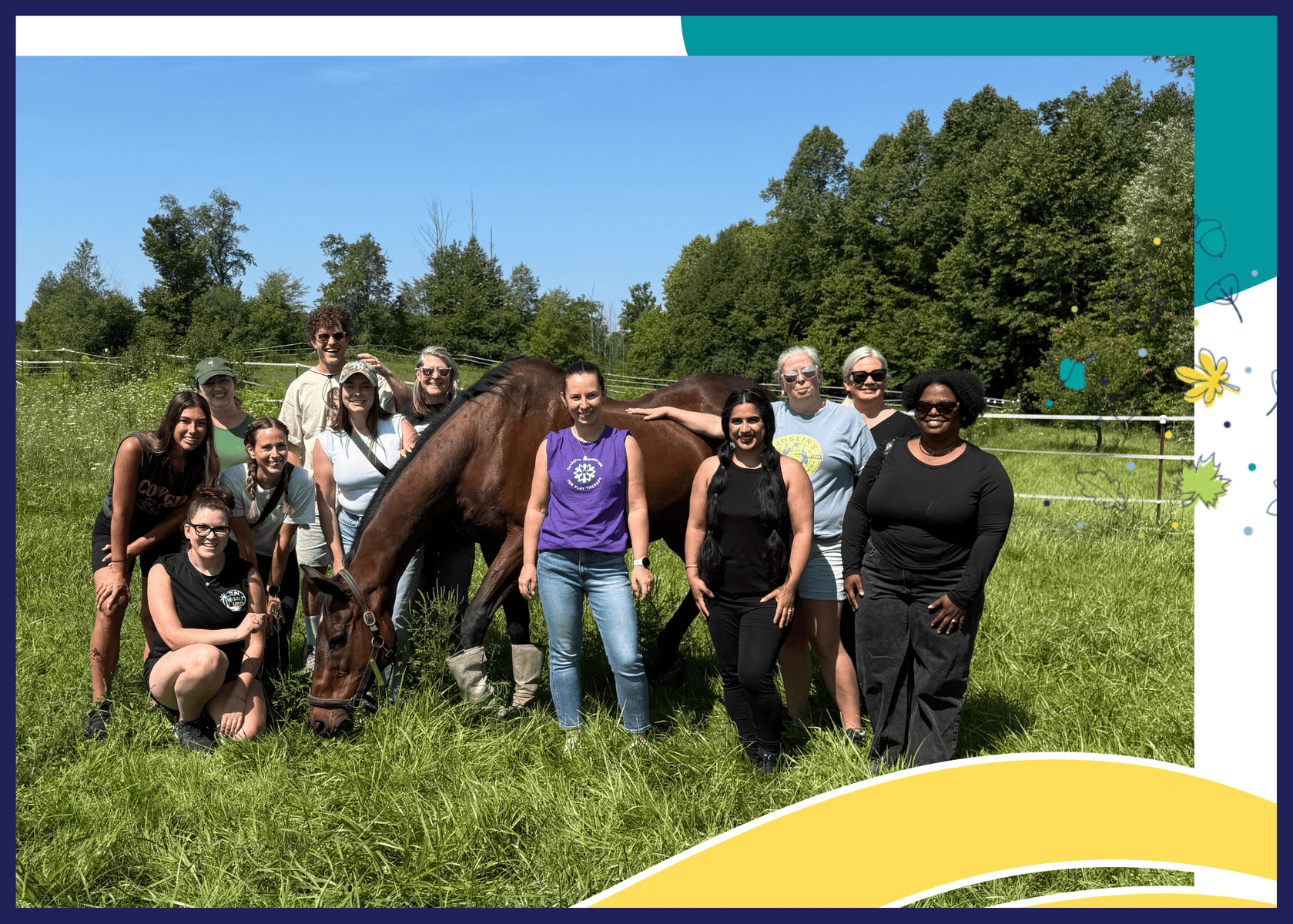
Recently, our team at Acorn Counselling had the opportunity to step outside the therapy room and into a pasture for a professional development workshop with Brittany Madigan, an equine-assisted therapist, and her incredible horse, Santé, along with several other resident horses she partners with in her work.
It wasn’t simply a chance to meet some beautiful horses. It was an opportunity to experience firsthand why equine therapy has become such a powerful and evidence-informed approach for supporting emotional wellness, trauma recovery, anxiety, self-awareness, and personal growth.
By the end of the afternoon, I don’t think any of us were talking about horses quite the same way.
What Is Equine Therapy?
Equine therapy (also called equine-assisted psychotherapy or equine-assisted learning) is a therapeutic approach that intentionally incorporates horses into the counselling process. Rather than being something to “ride,” the horse becomes an active participant in therapy—a co-therapist of sorts.
Sessions may involve grooming, walking, observing, or completing activities alongside a horse. Some programs include riding, while many, including Brittany’s work, focus primarily on interactions from the ground.
Unlike humans, horses don’t know our life stories.
They don’t know our diagnoses.
They don’t know what happened to us yesterday.
They don’t listen to the narratives we tell ourselves or others.
Instead, horses respond to something much more immediate.
They respond to our nervous systems.
Horses Don’t Hear Our Words. They Feel Our Presence.
One of the first things Brittany shared with us was that horses are prey animals.
Unlike predators, whose nervous systems often seek control or dominance, prey animals survive by constantly reading the environment around them for signs of safety or danger. They notice incredibly subtle changes in posture, breathing, muscle tension, energy, and intention.
In many ways, they are experts at reading non-verbal communication.
That means when we approach a horse feeling anxious, disconnected, overwhelmed, guarded, or uncertain, they often notice long before we’ve even become aware of it ourselves.
The remarkable part is that horses aren’t judging us.
They’re simply responding.
Their reactions become gentle, honest feedback about the state of our nervous system.
For many people, this can create moments of insight that are difficult to access through conversation alone.
Regulation Before Conversation
As therapists, we often talk about emotional regulation.
We know that before someone can solve problems, learn new skills, or process difficult experiences, their nervous system first needs to feel safe enough to do so.
Horses seem to understand this instinctively.
Unlike humans, horses don’t spend hours replaying yesterday’s mistakes or worrying about next week’s meeting.
They live in the present moment.
When something startles them, they react quickly—perhaps running, moving away, or vocalizing—but once the threat has passed, they naturally return to a regulated state. They shake, move, breathe, reconnect with their herd, and continue grazing.
Watching this happen was a gentle reminder that emotions are meant to move through us, not stay stuck inside us.
As humans, we often try to think our way through emotions.
Horses simply experience them.
Then they let them go.
The Power of Co-Regulation
One of the most beautiful concepts in equine therapy is co-regulation.
Our nervous systems are constantly influencing one another.
Parents know this well. A calm caregiver often helps a distressed child settle. Likewise, an anxious adult can unintentionally communicate that anxiety to the people around them.
The same can happen with horses.
As we slowed our breathing, softened our movements, and became more grounded ourselves, we often noticed the horses responding.
Their bodies relaxed.
Their curiosity increased.
Their willingness to engage changed.
It wasn’t about controlling the horse.
It was about changing ourselves.
That lesson feels incredibly relevant—not only in therapy, but in parenting, leadership, friendships, and everyday relationships.
Sometimes the greatest influence we have on others begins with regulating ourselves first.
Horses Live in Relationship
Horses are deeply social animals.
In the wild, they survive in herds, relying on one another for protection, connection, and belonging.
They communicate constantly—not through words, but through body language, movement, distance, posture, and subtle shifts in attention.
Watching them interact was fascinating.
Sometimes they approached one another with curiosity.
Sometimes they respected another horse’s need for space.
Sometimes they gently established boundaries.
There was very little force.
Very little drama.
Just clear communication.
As therapists, we couldn’t help but notice how much these interactions reflected healthy human relationships.
Connection.
Boundaries.
Curiosity.
Respect.
Repair.
Many of the things we hope to cultivate in counselling were happening naturally right in front of us.
Nature Is Part of the Therapy Too
One aspect of equine therapy that often gets overlooked is the setting itself.
Therapy usually takes place outdoors, surrounded by open fields, trees, fresh air, changing weather, and the sounds of nature.
There is growing research showing that time spent in natural environments can reduce stress, improve mood, support attention, and calm our nervous systems.
Before we even interacted with the horses, many of us noticed ourselves slowing down.
Phones stayed in pockets.
Conversations became quieter.
Breathing deepened.
The environment itself invited mindfulness.
The horses simply helped us go a little further.
What Our Team Learned
Throughout the afternoon, Brittany guided us through several activities designed to encourage teamwork, communication, leadership, and reflection.
Each challenge required us to work together while remaining aware of both ourselves and the horses.
One thing became clear very quickly.
The horses were not interested in following someone simply because they spoke the loudest.
They responded to authenticity.
Calm. Confidence. Consistency.
One of my favourite moments was watching our Clinical Manager, Marsha, naturally step into leadership.
She wasn’t loud.
She wasn’t forceful.
She simply brought a calm, gentle, confident presence that both the horses and our team seemed to trust.
It was a beautiful reminder that leadership often isn’t about directing people.
It’s about creating enough safety that others naturally choose to follow.
Throughout the afternoon, every member of our team had opportunities to interact with the horses in different ways.
Some moments invited problem-solving.
Others encouraged patience.
Some required slowing down.
Others required stepping forward with intention.
There were lots of laughs, but also many quiet moments of reflection.
The horses had a remarkable way of drawing our attention back to ourselves.
Slow Down. Trust the Process.
As therapists, it’s easy to feel pressure to help people find answers.
To fix.
To guide.
To solve.
One of the greatest gifts of the day was being reminded that healing rarely needs to be rushed.
Again and again, we noticed that forcing an interaction with a horse almost never worked.
Trying harder wasn’t the answer.
Moving faster wasn’t the answer.
Instead, change happened when we slowed down.
When we became curious.
When we paid attention.
When we created enough safety for connection to happen naturally.
That feels remarkably similar to the counselling process itself.
Real growth often unfolds when people feel seen, understood, and emotionally safe—not when they’re pushed before they’re ready.
Safety and Openness
If I had to summarize the entire experience in two words, they would be safety and openness.
Safety allows curiosity.
Curiosity allows awareness.
Awareness creates choice.
And choice is where lasting change begins.
Whether we’re sitting beside a client, parenting a child, supporting a friend, leading a team, or standing quietly beside a horse, the same principle seems to hold true:
People—and horses—respond best when they feel safe.
Could Equine Therapy Be Right for You?
While equine therapy may not replace traditional counselling, it can be an incredibly meaningful complement for many people.
It may be especially helpful for individuals who find it difficult to express emotions with words, those living with anxiety, trauma, stress, grief, low self-esteem, or relationship challenges, and anyone who feels more comfortable learning through experience than conversation alone.
The horses don’t expect perfection.
They aren’t interested in appearances.
They don’t ask you to explain yourself.
They simply invite you to show up exactly as you are.
And sometimes, that’s where healing begins.
Interested in Learning More?
If you’re curious about equine therapy, we’d highly recommend connecting with Brittany Madigan, who offers equine-assisted therapy for individuals aged 12 and older just outside Hamilton in Puslinch, Ontario.
Our team left the experience feeling grounded, inspired, and reminded of something we often tell our own clients: healing doesn’t always happen through having the perfect words. Sometimes it begins with slowing down, feeling safe, becoming curious, and allowing change to unfold naturally.
For us, the horses were wonderful teachers.